


Validation of uterine artery embolization before surgical laparoscopic myomenucleation compared to single surgical laparoscopic myomenucleation for the treatment of large fibroids and uterus myomatosus
Source : https://www.frontiersin.org/articles/10.3389/fmed.2023.1145952/full
AimTo determine the efficacy of preoperative uterine artery embolization (uterine artery embolization; UAE) prior to elective laparoscopic fibroid removal compared to single laparoscopic fibroid removal in women with large uterine...
Conclusion: Especially women with large uterine fibroids and women with uterus myomatosus after having children can benefit from the combination therapy of preoperative percutaneous uterine embolization with subsequent laparoscopic myoma enucleation.
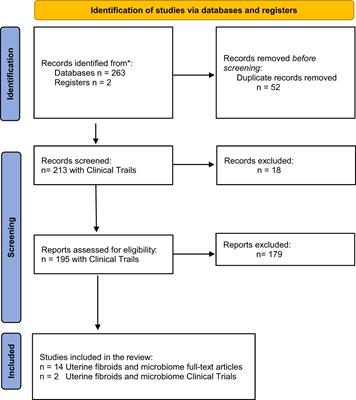
The role of microbiota in the pathophysiology of uterine fibroids - a systematic review
Source : https://doi.org/10.3389/fcimb.2023.1177366
For a long time, the uterus had been considered a sterile organ, meaning that under physiological conditions the uterus would not be colonized by bacteria. Based on available data, it...
Conclusion: This systematic review presents the relationship between intestinal and uterine dysbiosis and uterine fibroids. It may be concluded that the gut and uterine microbiome are related and that the role of this microbiome is greater than expected.
Comparison of Postoperative Quality of Life Scores in Women Who Underwent Myomectomy Versus Hysterectomy for Uterine Fibroids
Clinic IRB, we conducted a retrospective cohort study for patients that underwent hysterectomy or myomectomy for uterine fibroids. Eligible patients were sent validated surveys: 36-Item Short Form Health Survey (SF-36)...
Conclusion: While patients who underwent hysterectomy reported more fatigue, they experienced lower symptom severity, lower levels of concern, higher activity tolerance, and increased sense of control compared to myomectomy. These findings may help guide counseling for surgical fibroid treatment.

Global, regional, and national time trends in incidence, prevalence, years lived with disability for uterine fibroids, 1990-2019: an age-period-cohort analysis for the global burden of disease 2019 study - BMC Public Health
Source : https://bmcpublichealth.biomedcentral.com/articles/10.1186/s12889-023-15765-x
Background Uterine fibroids are the most common benign neoplasm of the uterus and a major source of morbidity for women. We report an overview of trends in uterine fibroids of...
Discussion: High SDI and high-middle SDI quintiles with decreasing trends of incidence rate, prevalence rate and YLDs rate, increasing trends were observed in middle SDI, low-middle SDI and low SDI quintiles over the past 30 years. Reproductive women aged 35–39 years had the highest risk of incidence rate and aged 40–44 years had the...

Impact of FIGO type 3 uterine fibroids on in vitro fertilization outcomes: A systematic review and meta-analysis - PubMed
Source : https://pubmed.ncbi.nlm.nih.gov/37183601/
FIGO type 3 myomas are significantly associated with a lower implantation rate, cumulative pregnancy rate, and live birth rate. Furthermore, their deleterious effect on the outcome of IVF increases further...
Conclusion: FIGO type 3 myomas are significantly associated with a lower implantation rate, cumulative pregnancy rate, and live birth rate. Furthermore, their deleterious effect on the outcome of IVF increases further with increasing size and number. Nevertheless, no firm conclusions could be drawn about the potential benefits of surgery for...